

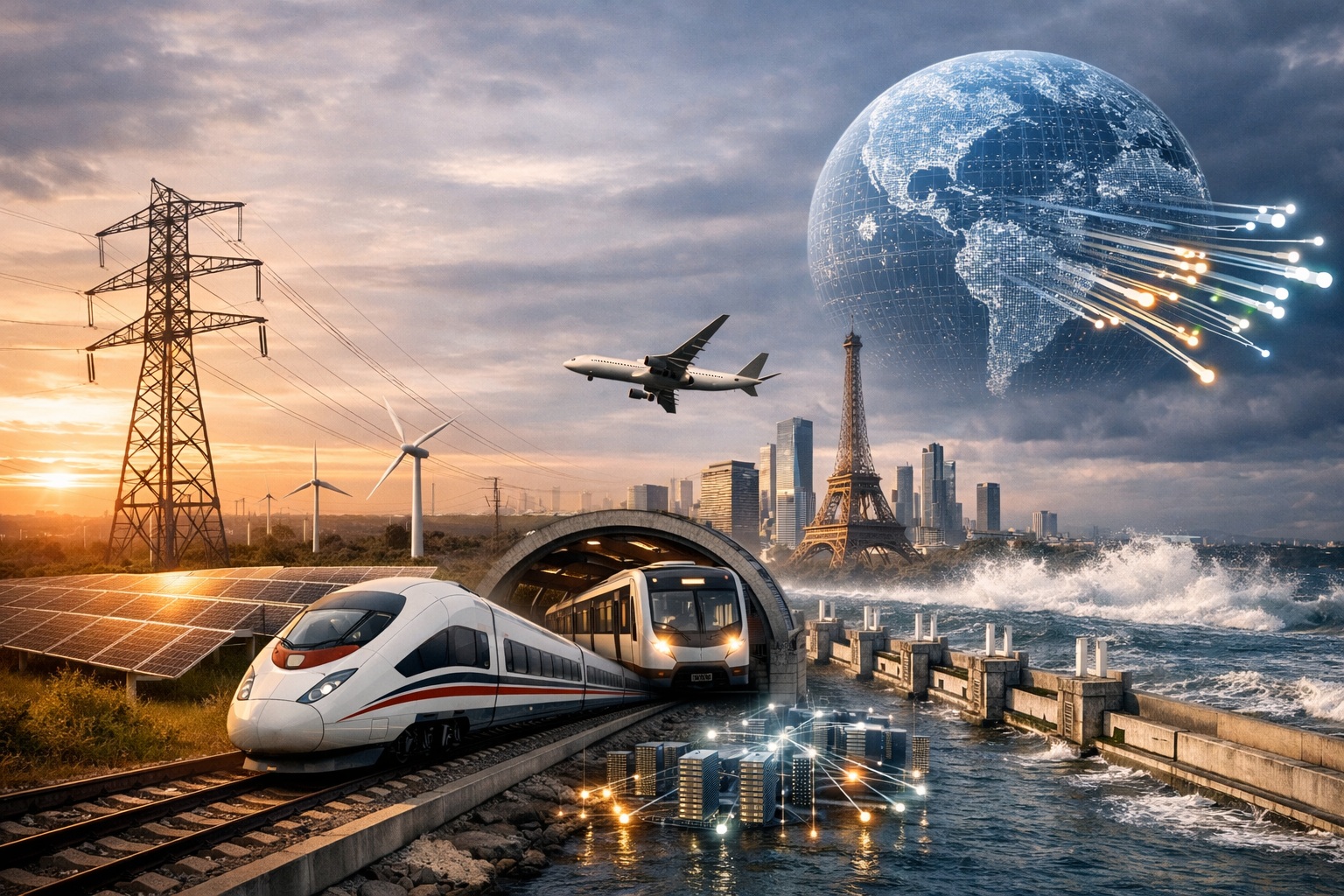
"For decades, European infrastructure policy meant motorways, gas pipelines, and electricity pylons. That consensus is finished. What has taken its place is something sharper, more urgent — and, if the investment figures are to be believed, far more expensive"
The continent is not short of ambition. The Boston Consulting Group estimates that Europe requires roughly €800 billion per year through 2040 to meet its infrastructure, climate, and competitiveness goals — more than double the historic rate of spend. The Draghi report on European competitiveness named infrastructure deficits as a structural drag on growth. And a wave of geopolitical shocks, from Russia's energy aggression to suspected Baltic Sea sabotage, has concentrated political minds in ways that parliamentary White Papers rarely manage. The result is a new hierarchy of priorities. Energy security has displaced transport as the defining infrastructure challenge. Rail is being reframed as strategic defence, not just transport convenience. Urban mobility is morphing from a planning problem into an emissions emergency. The digital backbone is now
The New Hierarchy of European Infrastructure Five priorities have displaced the old order of roads and pipes — and the projects delivering them are remaking a continent regarded as critical national infrastructure in the same breath as water and power. And resilience — the hard-won ability to absorb shocks — has graduated from a footnote to a founding principle. These are not five separate conversations. They are deeply intertwined, and the projects leading each area increasingly know it. Here is where Europe's infrastructure story stands in 2026
PRIORITY ONE Energy Security — Building Independence, Cable by Cable
No single shift has reordered European infrastructure thinking more completely than the move toward energy independence. The continent that once outsourced its energy security to pipeline politics is now spending at a pace that would have seemed unthinkable a decade ago. The Baltic Sea is the theatre where this transformation is most visible. On 9 February 2025, the three Baltic States successfully synchronised their electricity systems with the Continental European Network via Poland — a technical milestone with unmistakably geopolitical dimensions, cutting the last formal electrical link to the Russian grid. The feat required years of cross-border coordination, the Harmony Link interconnector between Lithuania and Poland, and the political will to absorb significant transition costs. It was completed on schedule
PROJECT SPOTLIGHT
Baltic-German PowerLink & Aurora Line: Germany, Latvia, and Lithuania have signed a declaration of intent for the Baltic-German PowerLink — a proposed 600km subsea cable integrating up to 2GW of offshore wind into regional grids. Meanwhile, the 'Aurora Line' interconnector between Finland and Sweden was inaugurated on 29 January 2026, reinforcing cross-border capacity in the Nordic arc. Baltic TSOs have agreed a roadmap targeting a sevenfold expansion of Baltic offshore wind by 2030 against a current installed base of under 5GW — in a sea with an estimated potential of 93GW.
Offshore wind is the engine of this transformation. Ørsted and PGE's Baltica 2 project and the 1.1GW Baltic Power installation represent some of the most complex construction operations currently active in European waters, involving over 500 crew and twenty vessels at peak. The UK's Allocation Round 7, completed in early 2026, awarded 8.4GW of new capacity in the largest single offshore wind auction in European history.
Hydrogen is the second pillar. Spain's H2Med initiative has fast-tracked 11GW of renewable-powered hydrogen corridors. The EU Hydrogen Bank's first auction cleared in early 2025 at a weighted average of €0.48 per kilogram, with Dutch Spanish bids at the lower end of the range — a signal that the economics of green hydrogen are compressing faster than many analysts expected. Germany's H2Global contracts-for-difference provide ten-year offtake guarantees to anchor private investment. Together, these instruments are constructing the scaffolding of a hydrogen economy — not announcing it, building it.
PRIORITY TWO Rail Connectivity — From Transport to Strategic Asset
Rail has always been Europe's preferred mode of self-congratulation — grand stations, high-speed corridors, decades of planning documents. What is different now is the vocabulary. Rail CEOs gathered in Brussels in early 2026 and agreed priorities that included not just ticketing interoperability and ERTMS digitalisation, but military mobility. The EU's November 2025 Military Mobility Package explicitly framed rail as a defence asset, raising the prospect of what CER has called a "Military Schengen" — harmonised rules allowing the rapid movement of troops and equipment across borders by rail.
PROJECT SPOTLIGHT: European High-Speed Rail Plan & ERTMS: The Commission published its High Speed Rail acceleration plan in November 2025, aiming for cross-border journey times that could shift modal behaviour away from short-haul aviation. Three in four European citizens say they would choose high-speed rail over flying for intra-EU journeys, given the right connectivity. The European Rail Traffic Management System (ERTMS) programme — a continent-wide digital signalling overhaul — is now being supported by satellite positioning through the EGNOS4Rail initiative, integrating Europe's Galileo and EGNOS space infrastructure with on-the-ground operations for the first time.
The economic case is striking. Rail contributes €247 billion to the EU economy and supports 3.1 million jobs. It is nine times more CO₂-efficient and seven times more energy-efficient than road freight — facts that land differently when Europe is importing nearly 60 percent of its energy needs from outside the bloc. CER has called on the forthcoming Multiannual Financial Framework to treat rail investment as a pillar of strategic autonomy, not merely a climate measure. The permitting and financing challenges remain real. Cross-border high-speed corridors require alignment across multiple regulatory regimes, and many of the most-needed links — the Lyon-Turin tunnel, the Rail Baltica project connecting Estonia, Latvia, and Lithuania to the European network — have tested the patience of project developers and government sponsors alike. Rail Baltica remains one of the most strategically significant infrastructure projects on the continent, physically connecting the Baltic states to Western Europe by standard-gauge rail for the first time.
PRIORITY THREE Urban Mobility — The Zero-Emission Overhaul of City Movement
Transport accounts for 25 percent of Europe's greenhouse gas emissions and that share is growing, not falling. Without a step-change in urban mobility, the EU's 2050 net-zero target for transport — a 90 percent reduction — becomes a number on a policy document rather than a trajectory. Sixty percent of European mayors rank expanding public transport networks as one of their top three priorities. The gap between ambition and funding is their most cited challenge.
The fleet transition is, however, accelerating. Between January and June 2025, 279 hydrogen buses were registered across Europe — a 426 percent increase on the same period in 2024. Solaris, which holds 58 percent of the European hydrogen bus market, recently won a contract to supply 130 units to Bologna. In Oslo, 85 percent of public bus kilometres travelled are now fully electric. Cities in the Netherlands, Finland, and Norway are leading a transformation in zero-emission fleet procurement that is beginning to migrate, unevenly, into Central and Eastern Europe.
PROJECT SPOTLIGHT: Rome Metro Line C & the Jubilee Legacy: Rome used the pressure of 50 million visitors during the 2025 Catholic Jubilee as a forcing function for long-deferred investment — €530 million in public transport upgrades, including two new stations on Metro Line C, 465 electric buses, and a 180km² low-emission zone. The city's Deputy Mayor described it as using the Jubilee not to manage an event but to catalyse permanent improvement. It is a model other European cities facing event-driven infrastructure moments — from World Cups to EU Presidencies — would do well to study.
The multimodal integration agenda is where the harder work lies. Nineteen percent of European cities report that poor integration between public transport and cycling or walking infrastructure is a significant barrier to ridership. Digitalisation in ticketing and payment — exemplified by Budapest's MOL Bubi cycling system, which saw ridership multiply five-to-eightfold after digitalising payments — is proving to be as important as physical infrastructure expansion. In some cities, software upgrades are delivering more mode-shift than steel and concrete.
PRIORITY FOUR Digital Backbone — Cables, Compute, and Sovereignty
Subsea cables carry over 95 percent of international internet traffic. For most of the last decade, European infrastructure policy treated them as commercial telecoms infrastructure — a matter for markets, not ministries. That has changed with remarkable speed. Following suspected sabotage incidents targeting Baltic Sea cables and pipelines, subsea infrastructure has been reclassified as critical national infrastructure in multiple member states. The EU's Cable Security Action Plan, backed by a confirmed €540 million investment to 2027 under CEF Digital, now includes plans for a Cable Vessels Reserve Fleet — specialist ships positioned for rapid emergency repair deployment.
PROJECT SPOTLIGHT: Project Waterworth, EAGLE & Portugal's Sines: Meta's Project Waterworth — a 50,000km private cable system linking five continents — will make landfall in Europe as part of a wave of hyperscaler-owned infrastructure that is redrawing the geography of connectivity. In parallel, the EU has endorsed the EAGLE (Egypt-Albania Gateway Link to Europe) subsea project, a 2,000km cable linking Albania and Egypt to create a new digital corridor into the Western Balkans, operational by 2028. At Sines on Portugal's Atlantic coast, Start Campus's SIN01 data centre reached 33MW in early 2026, leveraging Portugal's unique position as the only European landing point for direct subsea links to South America.
Data centre investment across Europe is expected to exceed €100 billion by 2030 as AI infrastructure demand reshapes where and how capacity is built. Frankfurt, long the continent's hub, is constrained by power and space. The market is bifurcating: latency-sensitive workloads staying in FLAP-D cities (Frankfurt, London, Amsterdam, Paris, Dublin), with large-scale AI training moving to regions offering cheaper land, cleaner power, and faster planning approvals. Warsaw has emerged as the primary Sovereign Cloud hub for Central and Eastern Europe. Milan has completed the transition from secondary to primary market. Spain and Italy are the continent's fastest-growing data centre markets.
Only 9 percent of European firms are currently fully prepared for AI adoption, according to Cisco's 2025 AI Readiness Index. The EU's forthcoming Cloud and AI Development Act aims to triple Europe's data centre processing capacity within five to seven years. The Digital Networks Act is designed to harmonise regulatory frameworks that currently fragment the continent's digital single market. Europe does not need to outspend the United States on AI compute to play a defining role in the global AI era — but it does need to get the underlying infrastructure right.
PRIORITY FIVE Resilience — The Infrastructure of Withstanding
Resilience used to be the infrastructure afterthought — the risk register item, the footnote in the business case. The events of recent years have promoted it to a founding principle. The EU's Critical Entities Resilience (CER) Directive, which entered a transitional implementation phase in early 2026, now covers eleven critical sectors including energy, transport, banking, digital infrastructure, and food supply. Every member state was required to adopt a national resilience strategy by January 2026 and to formally designate critical entities by July 2026. For many national governments, this is a novel exercise — not cataloguing risk, but building systems that absorb it.
PROJECT SPOTLIGHT: Baltic Sentry & Critical Infrastructure Protection: NATO's Baltic Sentry operation, launched in response to a series of suspected sabotage incidents involving undersea cables and pipelines in the Baltic Sea, represents the most explicit military deployment in defence of civilian infrastructure in the post-Cold War era. Baltic states are finalising an MoU on Critical Infrastructure Protection. Estonia has installed new radar that extends the viable area for onshore wind development from 10 to over 60 percent of the country — a resilience measure that doubles as a clean energy accelerant. The crossover between defence logic and infrastructure planning has never been more visible.
The September 2025 Commission Communication on Critical Entities Resilience provided non-binding guidance across all eleven sectors — but the voluntary nature of much of the framework has drawn criticism from those who argue that the Baltic Sentry moment demands binding obligations, not guidelines. The Grid Action Plan's twin pillars — a two-year permitting ceiling and smart grid digital twins — are similarly stalled between aspiration and regulation. Dry powder in European infrastructure funds stood at $355 billion in 2025, with LP surveys indicating a planned 5-7 percent increase in EU allocations by 2026. That capital is waiting for regulatory certainty that has not yet fully arrived.
BCG calculates that stronger resilience systems could cut Europe's gas import dependency by two-thirds, stabilise energy prices, and reduce annual climate related damages by €50 billion. The case for investing in resilience has never been more quantifiable. What is needed now is a planning and regulatory system that is itself resilient — capable of making decisions and granting approvals at the speed the moment demands.
The Interconnection Is the Point What unites all five of these priorities — and what marks them out as genuinely new, rather than recycled ambitions — is their interdependence. Energy security requires digital grid management. Rail investment depends on digital signalling and satellite positioning. Urban mobility transitions are powered by the same clean energy grid being built offshore. Digital backbone investment is constrained by the same power availability challenges as every other sector. And resilience is not a property of any single system but of the connections between them. an MoU on Critical Infrastructure Protection. Estonia has installed new radar that extends the viable area for onshore wind development from 10 to over 60 percent of the country — a resilience measure that doubles as a clean energy accelerant. The crossover between defence logic and infrastructure planning has never been more visible. Europe's infrastructure spend needs to more than double. Its project governance needs to improve dramatically — BCG estimates that current practices put the continent on course for €3 trillion in time and cost overruns. Its permitting frameworks need to become faster without becoming careless. And its capital mobilisation, which is beginning to shift in the right direction, needs to be anchored by the regulatory certainty that makes long-dated private investment viable. None of this is straightforward. But the old complaint about Europe — that it talks about infrastructure while others build it — is becoming harder to sustain. The Baltic synchronisation happened. The offshore auction records fell. The subsea cable investment is landing. The hydrogen corridors are being dug. The projects are real, they are underway, and the engineers are working. The question is whether the institutions, the regulations, and the capital structures can move at the same pace as the problems they are trying to solve. In 2026, that remains an open question. But it is, for the first time in a long while, a genuinely contested one