

Inside BCI Minerals’ plan to turn Australia’s largest solar salt operation into a multi-generational export platform
There is a point in every infrastructure project when the language changes.
For years, BCI Minerals’ Mardie Salt Operation and Potash Project could be described through approvals, finance, dredging plans, pond earthworks, marine structures, procurement packages and forecast production numbers. It was a project being advanced. A project being financed. A project being de-risked.
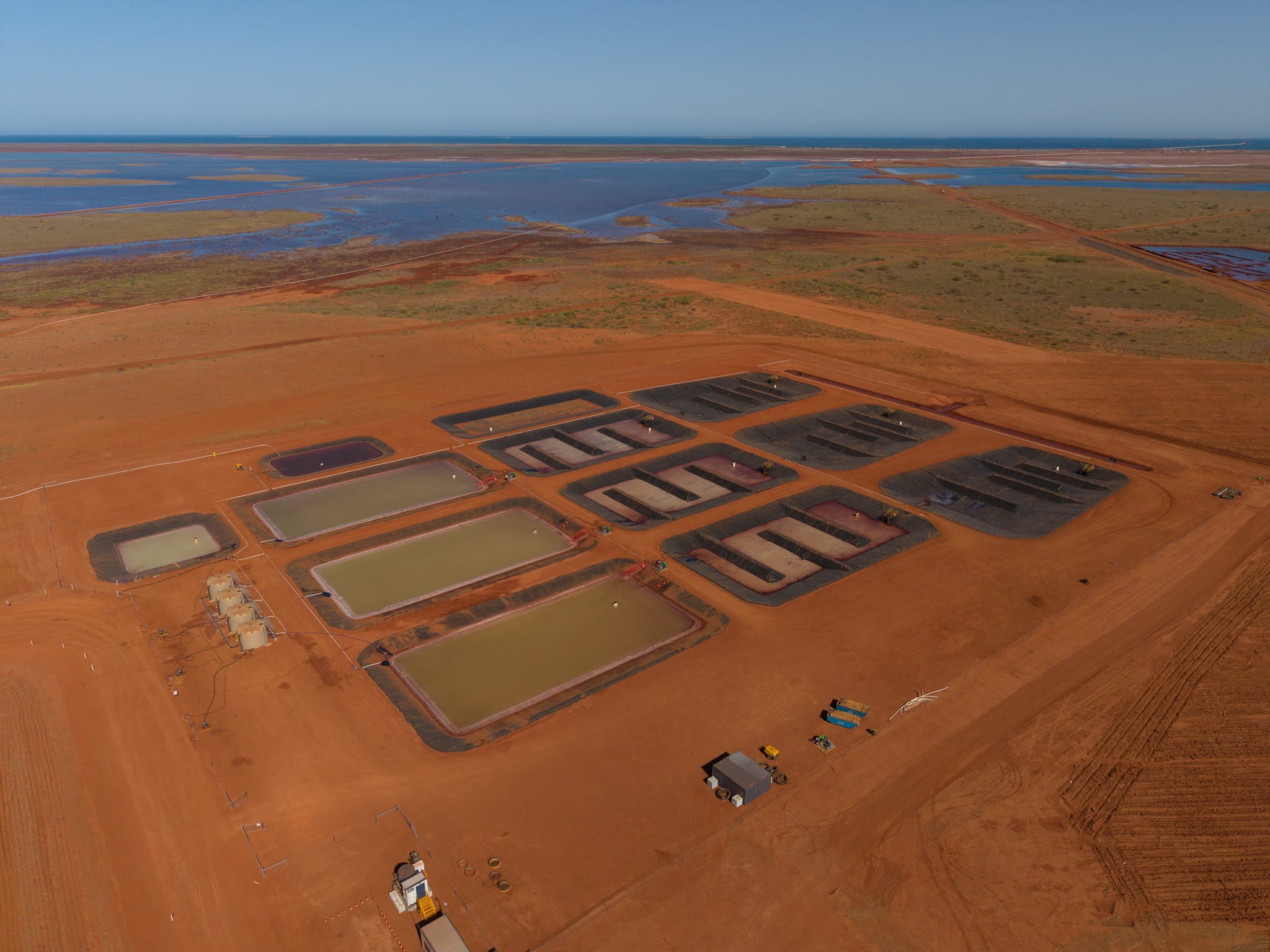
Then, in March 2026, high-density brine from Pond 9 moved into the first two lined crystallisers. Salt began forming. Not in a model. Not in a presentation. In the crystallisers. On the Pilbara coast. Inside the system BCI has spent years assembling. Managing Director David Boshoff put it plainly: “Mardie is a working salt operation.”
That sentence matters because Mardie has never been just another resource development. It is a rare kind of industrial project: one where the primary engine is not a crusher, a mill or a furnace, but climate. Seawater is drawn from the Indian Ocean, moved through a vast evaporation circuit, concentrated by heat and wind, transferred into crystallisers, harvested as high-purity industrial salt, washed, stockpiled and moved through a dedicated export system at Cape Preston West.
BCI describes Mardie, located about 80 kilometres south of Karratha, as the largest solar salt operation in Australia and the third largest in the world. The project spans more than 130 square kilometres and is designed to produce high-quality industrial salt and sulphate of potash, a premium fertiliser by-product, over a 60-plus-year operating life. BCI says the operation is expected to contribute A$4.8 billion to GDP over that period.
The project’s latest public numbers show how close the system is to the threshold between construction and sustained operations. BCI’s March 2026 quarterly report recorded overall construction progress at 81 per cent, cumulative Mardie expenditure of A$1.369 billion, construction cost to date of A$1.110 billion, and estimated construction cost to complete of A$333 million. Available funds stood at A$522 million.
Those numbers matter. But they are not the story by themselves.
The real story is whether a 130-square-kilometre coastal production system can be brought into rhythm: seawater intake, pond density, transfer stations, crystalliser lining, salt pavement, wash plant, stockyard, jetty, dredged channel, transshipment and customer delivery. Mardie will not be judged by whether it is large. That is already clear. It will be judged by whether its many parts behave as one industrial machine.
THE PROJECT IS THE PROCESS
To understand Mardie, it helps to stop thinking of it as a mine.
A conventional mining project begins with a deposit, then builds infrastructure around the work of extraction. Mardie begins with an abundant seawater resource and builds infrastructure around the work of concentration. Its geology matters, but not in the usual way. The value of the site is not locked underground. It sits in the relationship between coastal access, clay-rich mudflats, high evaporation, low rainfall, wind, distance to Asian markets and the ability to build ponds at enormous scale.
The production concept is simple enough to describe in one sentence: pump seawater into ponds and let solar and wind evaporation concentrate it until salt and potash-bearing brines can be recovered. But the simplicity is deceptive. At Mardie’s scale, evaporation becomes a civil, mechanical, marine, environmental and operational challenge.
Stantec, which has served as Project Management Contractor, says the project includes nine evaporation ponds and an operating life of at least 60 years, with packages spanning the salt wash plant and stockyard, SOP process plant, non-process infrastructure, seawater station, pump stations, overland pipelines, jetty construction, evaporative ponds, crystallisers, power and communications.
That is the infrastructure reality behind the clean sustainability narrative. Solar evaporation may sound passive. Mardie is not passive. It is a production system that has to move, measure and manage water at industrial scale, over years, through a landscape exposed to heat, salinity, cyclone risk and the timing discipline of salt formation.
The current design target is approximately 5.3 million tonnes per annum of high-purity salt, above 99.5 per cent sodium chloride, and 140,000 tonnes per annum of sulphate of potash, above 52 per cent K2O. Main construction commenced in early 2022, and operations commenced in September 2024.
The difference between “operations commenced” and “steady-state production” is where Mardie now lives.
POND 9 IS THE TEST
At Mardie, Pond 9 has become more than a number on a layout plan. It is the immediate operating test of whether the front end of the evaporation circuit is delivering the brine density needed for salt production.
During the March 2026 quarter, BCI commissioned the brine channel connecting the ponds to the crystallisers, commissioned the first two lift stations, and flooded the first two lined crystallisers with high-density brine from Pond 9. That enabled the formation of salt pavement in the crystallisers, a critical step toward first salt production.
This is the point where the project becomes unforgiving. Earthworks can be reported in percentages. Marine construction can be measured in piles, metres and completion rates. Brine density is more exposed. It depends on weather, evaporation, seasonal patterns, rainfall, wind and operational control across the circuit.
That vulnerability became visible in the same quarter. Tropical Cyclones Mitchell and Narelle passed through Mardie with no material impact to personnel, plant, equipment or infrastructure and without loss of brine. In a construction and safety sense, that was a major positive. But the cyclones brought more rainwater into the circuit than anticipated, delaying the crystalliser lining program and reducing pond density levels. BCI has stated that timing for First Salt on Ship remains weather dependent.
That is not a footnote. It is the operating truth of a solar salt project.
Mardie’s advantage is that it uses natural energy. Its challenge is that natural energy arrives on its own terms. Heat, wind and evaporation are production inputs. Rainfall is a production interruption. The project’s resilience will depend not only on built infrastructure, but on how quickly the operations team learns the behaviour of the ponds under real Pilbara conditions.
BCI says salt operations resumed after the quarter, with pond density increasing and salt reforming in the crystallisers. It is also refining the salt production ramp-up profile based on operational experience, site performance and insights from its digital twin.
That last detail matters. Mardie is often described through its natural simplicity. But the operational future will depend heavily on data: density, salinity, flow, evaporation, pond levels, transfer timing, salt pavement behaviour, wash plant throughput and the interface between the evaporation circuit and export logistics.
THE PONDS ARE THE PLANT
In most industrial features, the plant is where the machinery is.
At Mardie, the ponds are the plant.
They are not storage basins. They are the primary processing infrastructure. Each pond is part of a sequence in which seawater becomes progressively more concentrated. If the ponds perform, everything downstream has a chance. If they underperform, the crystallisers, wash plant, stockyard and port wait for feed that has not yet reached the right state.
That is why the project’s early engineering work matters. The Definitive Feasibility Study, completed in 2020, was managed by BCI with GR Engineering Services as lead DFS engineer and support from Worley, CMW Geosciences, Preston Consulting, RPS, Roskill, Argus Consulting, Braemar ACM Shipbroking, KPMG and others. The DFS set out the project logic: seawater concentrated through solar and wind evaporation, nine evaporation ponds, salt and SOP crystallisers, process plants and a multi-user port concept.
The project has changed and grown since that DFS baseline, but the core discipline remains the same. Mardie is a sequencing project. Every piece of infrastructure exists to protect that sequence.
The primary seawater intake must move water reliably. Transfer stations must sustain volume. Pond embankments must hold shape and level. Crystallisers must be lined to create a safer and more predictable harvesting environment. The salt wash plant must be ready when harvest begins. The port must be able to receive, handle and move salt into the export chain.
BCI reported average utilisation of 95 per cent across the primary seawater intake and transfer stations during the March quarter. It also reported that salt wash plant design had reached 92 per cent completion, with major procurement items on track for delivery in the June 2026 quarter. Construction of the Pilbara Ports road, described as the final major civil works package, remained on track for completion in the September 2026 quarter.
That is what the market will watch next. Not simply “is Mardie complete?” but: are the system’s interfaces maturing in the right order?
THE PORT IS DESTINY
Every bulk project eventually becomes a logistics project.
Mardie is no exception. BCI can build ponds, generate brine, form salt and wash product, but the commercial value sits on the other side of export reliability. Salt has to move from the Pilbara coast into Asian industrial supply chains at a cost and rhythm that makes the project competitive.
That is the role of the Port of Cape Preston West.
BCI describes the port as a critical enabler of Mardie and a strategic advantage because it gives the company control from seawater intake to ocean-going vessel loading. The port is purpose-built for Mardie’s industrial salt and SOP export volumes, but BCI also frames it as a regional infrastructure asset with future potential for third-party users.
The numbers explain why. Cape Preston West includes a 2.4-kilometre jetty enabling transhipping to Newcastle Max vessels, loading of ocean-going vessels, and surplus export capacity of up to 14.5 million tonnes per annum using existing infrastructure. It is centrally positioned on the Pilbara coast, 227 kilometres from Ashburton and 305 kilometres from Port Hedland.
The marine works are substantial in their own right. McConnell Dowell’s marine structures package includes a piled 2.4-kilometre jetty with head-end platform, berthing and mooring dolphins, more than 200 steel piles up to 30 metres long, a materials handling conveyor system including shiploader, and non-process infrastructure such as fire suppression, amenities, craneage, navigation aids, lighting and ancillary systems.
The engineering story here is not only scale. It is construction method. McConnell Dowell says it used an innovative canti-traveller system to complete approximately 100 metres of jetty every 10 days while reducing construction footprint and impact in the coastal environment.
By the March 2026 quarter, BCI reported that construction of the marine package at Cape Preston West had reached 94 per cent completion. It also said dredging commenced on 27 April 2026, covering the berth pocket and navigation channel required to load deep-sea, ocean-going vessels with industrial salt from Mardie.
That makes the port one of the defining pieces of Mardie’s long-term value. If it works only for BCI, it is a major export facility. If it becomes useful to other regional developments, it becomes something larger: a shared logistics platform in a region where port access can make or break project economics.
FINANCING THE UNUSUAL
Mardie’s financing story is important because the project was difficult to classify.
It is large, long-life and strategic, but industrial salt does not behave like iron ore or copper in capital markets. Export Finance Australia notes that BCI needed additional finance to cover operational and capital expenditure, and that the salt commodity created financing challenges because it does not have a transparent index and relies on annual closed-door contracting cycles between buyers and sellers.
That problem cuts to the heart of Mardie’s development. The project has the physical profile of large infrastructure, the operating logic of a process industry, and the revenue structure of a bulk commodity without the same price visibility as more familiar resources.
Public finance helped bridge that gap. NAIF supported the project with a loan of up to A$490 million, describing Mardie as a major development in the Pilbara that will produce and export high-quality salt from seawater using solar and wind energy. NAIF says its early support helped attract additional debt and equity investment by strengthening confidence in the project’s financial structure.
Export Finance Australia later joined the broader lending syndicate, providing a A$160 million loan with an 11-year tenor in 2023. It also introduced BCI to Export Development Canada, which provided an additional A$150 million in finance.
That financing structure reflects a wider reality. Mardie is not a short-life mining bet. It is infrastructure with a resource product attached to it. Its payback depends on getting through construction, commissioning, ramp-up and into a long operating period where the competitive advantages of climate, location and logistics can compound.
ESG IS NOT A SIDE PROGRAM
Mardie’s ESG claim begins with its process.
BCI’s environmental materials state that the operation relies on sun and wind energy to produce salt through evaporation, resulting in a significantly lower carbon footprint than conventional mining operations. The company also says climate adaptability has been central to the design and location of project infrastructure, including resilience against increased cyclone frequency and intensity, sea-level rise and extreme weather.
That is the strength of the project’s environmental case. The core production method is not an offset to the business. It is the business.
But the project’s environmental responsibilities are also more complex than that. Mardie sits in a coastal environment where mangroves, algal mats, samphire, seagrass, marine turtles, migratory shorebirds, feral fauna and marine pests require ongoing monitoring. BCI says its routine environmental surveys include benthic communities and habitat monitoring, marine water quality monitoring aligned with dredging programs, and an extensive network of groundwater monitoring bores for real-time groundwater level and salinity monitoring.
The company is also collaborating with the Western Australian Marine Science Institution to fund marine and intertidal research through the Mardie Project Marine and Intertidal Research Offsets Program, linked to environmental approval conditions.
This is where Mardie becomes a test case. The project’s low-carbon production method does not remove environmental risk. It changes its character. The key issues are not tailings dams and diesel-intensive haulage in the conventional sense. They are coastal hydrology, marine quality, habitat protection, groundwater salinity, dredging impacts, brine management and cyclone resilience.
The ESG question is therefore not whether Mardie sounds sustainable. It is whether BCI can demonstrate that a very large coastal evaporation system can operate for decades while maintaining the environmental controls promised through approvals.
COUNTRY, CAPACITY AND COMMERCIAL PARTICIPATION
Mardie’s social licence will also be measured over decades.
BCI acknowledges the Yaburara and Mardudhunera People as the Mardie Traditional Owners. NAIF identifies the Yaburara and Mardudhunera people as Traditional Owners of the project area and notes that Wirrawandi Aboriginal Corporation represents Yaburara and Mardudhunera Native Title holders.
BCI says it works closely with Wirrawandi Aboriginal Corporation to ensure obligations under its Land Access Deed, Cultural Heritage Management Plan and Indigenous Engagement Strategy are relevant, fit for purpose and culturally appropriate. The company also says it works with Aboriginal partners to ensure project designs are sensitive to connection to Country and heritage values.
NAIF’s Indigenous engagement summary gives the commitments more structure. It says BCI is targeting First Nations employment of at least 5 per cent in the first year of construction, 7.5 per cent in the second year and 10 per cent in the third year, with an aim to maintain at least 10 per cent during operations. It also describes plans for an Aboriginal Procurement and Contracting Policy developed with Wirrawandi Aboriginal Corporation and Robe River Kuruma Aboriginal Corporation, including smaller accessible work packages and non-price evaluation criteria to support First Nations participation.
In 2025, NAIF says BCI awarded more than A$9 million in contracts to Aboriginal businesses and formalised a two-year A$480,200 capacity-building agreement to support WAC’s governance and organisational capability.
That is where the project’s social proof will sit. Not in the existence of targets. In whether those targets become durable capability.
A 60-year operation gives local and Indigenous businesses something construction alone rarely can: time. Time to move from participation to specialisation. Time to build governance. Time to form joint ventures. Time to train people into operational roles. Time to become embedded in the running of the system rather than attached to the temporary work of building it.
BCI’s March quarter update points in that direction. The company said it continued working with Wirrawandi Aboriginal Corporation and its newly established commercial arm, Manarri Enterprises, to support sustainable economic participation through Traditional Owner-owned businesses. It also reported cultural awareness training delivered by a Wirrawandi-owned business and facilitated by Yaburara and Mardudhunera Elders.
The difference between ESG language and ESG infrastructure is whether the relationship creates operating capacity. Mardie has the duration to do that. The next question is whether the procurement pathway becomes technical enough, commercial enough and consistent enough to matter across generations.
THE SOP SECOND ACT
Salt is the first business. Potash is the second act.
Mardie’s sulphate of potash pathway is important because it changes the economics and the industrial logic of the project. SOP is produced from the residual brines left after salt crystallisation, turning what could be treated as a lower-value stream into a premium fertiliser product.
BCI’s March 2026 quarterly report shows that the KTMS SOP trial crystallisers transitioned from batch testing to continuous steady-state operation. The company also completed assessment of submissions for the SOP Pilot Plant Preliminary Engineering Design and AACE Class 4 Capital Cost Estimate, selecting two proponents to progress the next phase ahead of a potential FEED study.
This is not the immediate test of Mardie. First salt is.
But SOP matters because it is the clearest example of how BCI wants Mardie to evolve from a large salt operation into a more integrated industrial minerals platform. The salt system proves the evaporation circuit, port chain and customer pathway. SOP adds value to the chemistry that remains.
For now, the project is rightly salt-first. First shipment, ramp-up and operating reliability must come before the broader value story can be fully tested.
WHAT MARDIE MEANS FOR THE PILBARA
Mardie is being built in a region that already understands export infrastructure.
The Pilbara is one of the world’s great resource corridors, but it is also a region where infrastructure has historically clustered around a few dominant commodities. Mardie adds a different kind of industrial asset: a large-scale solar evaporation operation producing salt and potash from seawater, with its own port and potential spare export capacity.
NAIF forecasts more than A$3.6 billion in public benefit to northern Australia over Mardie’s construction and operating life. It also forecasts 1,173 jobs, including a peak construction workforce of at least 476 people and an operating workforce of 697 people, plus additional indirect employment in the Pilbara.
Those figures are important because Mardie’s regional value is not just production. It is diversification. Salt is not iron ore. SOP is not LNG. Cape Preston West is not just another internal logistics asset if surplus capacity becomes available to others.
The project points toward a broader Pilbara possibility: a region where natural advantages are not limited to orebody extraction, but include climate, coast, industrial land, export access and long-duration infrastructure.
That does not make Mardie easy. It makes it consequential.
THE PROOFS STILL REQUIRED
Mardie has already proved several things.
It has proved that a large-scale solar salt project can reach advanced construction in Australia after decades without a comparable new development. It has proved that public finance can help unlock a difficult but strategic commodity project. It has proved that marine infrastructure can be pushed to near-completion on a remote Pilbara coast. It has proved that high-density brine can move from Pond 9 into crystallisers and begin forming salt.
But the proofs that matter most are still ahead.
The ponds must recover and sustain density after weather events. The crystalliser lining program must progress. Salt pavement must mature into harvestable product. The salt wash plant must transition from design and procurement into commissioning. The port must complete dredging, navigation, berthing, mooring and loading readiness. The first shipment must move. Then the system must ramp.
A project can be complete before it is mature. That is especially true at Mardie, where the primary production cycle is measured not in minutes on a conveyor but in months of evaporation.
First Salt on Ship will be an important milestone. It will not be the finish line. It will be the first public proof that the full chain — seawater, ponds, crystallisers, harvesting, washing, stockpiling, port handling and export — can behave as a commercial system.
Somewhere at Mardie now, salt is forming again in the first crystallisers. Pumps are moving brine. Transfer stations are being tested by use rather than design assumptions. Contractors are closing out packages. Port works are advancing. Environmental monitoring continues. Local businesses are watching the ramp-up because the project’s long life may shape their own.
That is the Mardie story.
Not a mine. Not just a salt field. Not only a port. A coastal industrial system being taught to run at scale.
If BCI can carry Mardie from first crystals to first shipment and then into stable ramp-up, the project will stand as one of the more unusual infrastructure achievements in modern Australian resources: a multigenerational export platform built from seawater, sun, wind, engineering discipline and time.