

How eThekwini is replacing a failing 70-year-old bulk-water artery with a more resilient, more intelligent and more maintainable system for 1.2 million people
Cities are rarely undone by the infrastructure people can see.
They are undone by the infrastructure buried beneath them — the pipes, cables, tunnels and networks that quietly keep life moving until age, pressure and deferred risk catch up with them. By the time a city begins talking seriously about replacing one of those systems, the problem is rarely theoretical. It is operational. It is political. It is economic. And it is already being felt in homes, schools, businesses and communities far from the exact point of failure.
That is the real story of the Southern Aqueduct in Durban.
Serving about 1.2 million people through 33 reservoirs, across a 160-km² supply zone, the Southern Aqueduct is one of the major hidden lifelines within eThekwini’s water network. It carries treated water south from Durban Heights Water Treatment Works toward densely populated communities and strategic economic areas that depend on reliable daily supply. Within the wider eThekwini Water and Sanitation system — which delivers approximately 910 Mℓ/day to around 3.7 million residents through 9 water purification works, 263 reservoirs and roughly 12,000 km of water mains it is a corridor of unusually high consequence.
And for years, it had become dangerously fragile.
What makes the Southern Aqueduct upgrade so compelling is that this is not simply a municipal replacement project. It is a case study in how a major African city responds when aging buried infrastructure can no longer meet rising demand, when maintenance itself becomes risky, and when the cost of inaction begins to spread across the social and economic life of the city.
This feature draws from an interview led by Abi Abagun, Director of Major Projects at BE Global Infrastructure, together with Wenzile Ndlovu, Editorial Project Manager at BE Global Infrastructure, with three key figures behind the scheme: Siduduzo Mtshali, Project Executive for Special Projects within the eThekwini Water and Sanitation Unit; Christopher Maine, a Professional Engineer at MMK Engineers providing specialist technical expertise on the Southern Aqueduct Project in the Durban Metropolitan Area; and Colin Raman, a highly experienced Civil Engineer and KwaZulu-Natal Regional Director at NAKO ILISO, where he plays a key role representing the consulting engineering team on the project.
Together, they described a project that is as much about resilience and future control as it is about pipe replacement. At the time of the interview, the project presentation showed overall progress at approximately 60%, with commissioning of Work Package 1 expected in April 2026 and Work Package 2 in June 2026, followed by the remaining packages later in the year.
A buried crisis
Mtshali, who led the early part of the conversation, set out the challenge in practical terms.
The original Southern Aqueduct system was based primarily on a 975-mm prestressed concrete pipeline paired with a 1,000-mm steel pipeline. Over time, the concrete line had become increasingly unreliable. The presentation prepared for the interview notes that the prestressed concrete SOCOMON pipes had suffered more than 15 joint leaks, and that approximately 50% of the prestressed concrete sections had been decommissioned because of structural failures.
That left the city with a shrinking margin for error.
In the interview, Mtshali described a network in which repeated interventions were no longer solving the problem. The old concrete pipe had reached the end of its useful life, original materials were no longer readily available, and operational teams had at times been forced to isolate sections simply to keep the wider system moving. The burden increasingly fell on the remaining steel line.
The consequences of that were not abstract. The aqueduct could no longer meet annual average daily demand in southernmost supply areas such as Umlazi, Folweni, Shallcross and Klaarwater, and hydraulic modelling found that even if the damaged prestressed concrete line were recommissioned, the system would still fail to meet peak summer demand.
In other words, Durban was not facing a maintenance problem. It was facing a capacity and resilience problem.
That distinction matters. It changes the story from one of repair to one of reinvention.
Replacing capacity — and redesigning maintainability
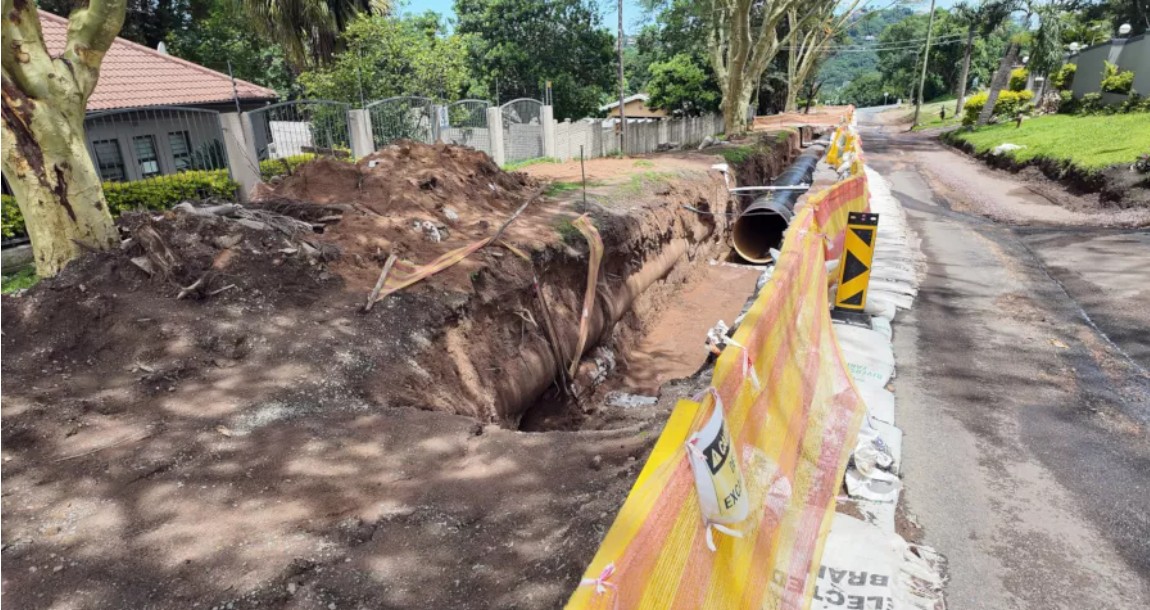
The replacement strategy is straightforward in headline terms: new steel pipes, larger diameters, phased delivery, and restored redundancy. But the more interesting story lies in *how* the system is being rebuilt.
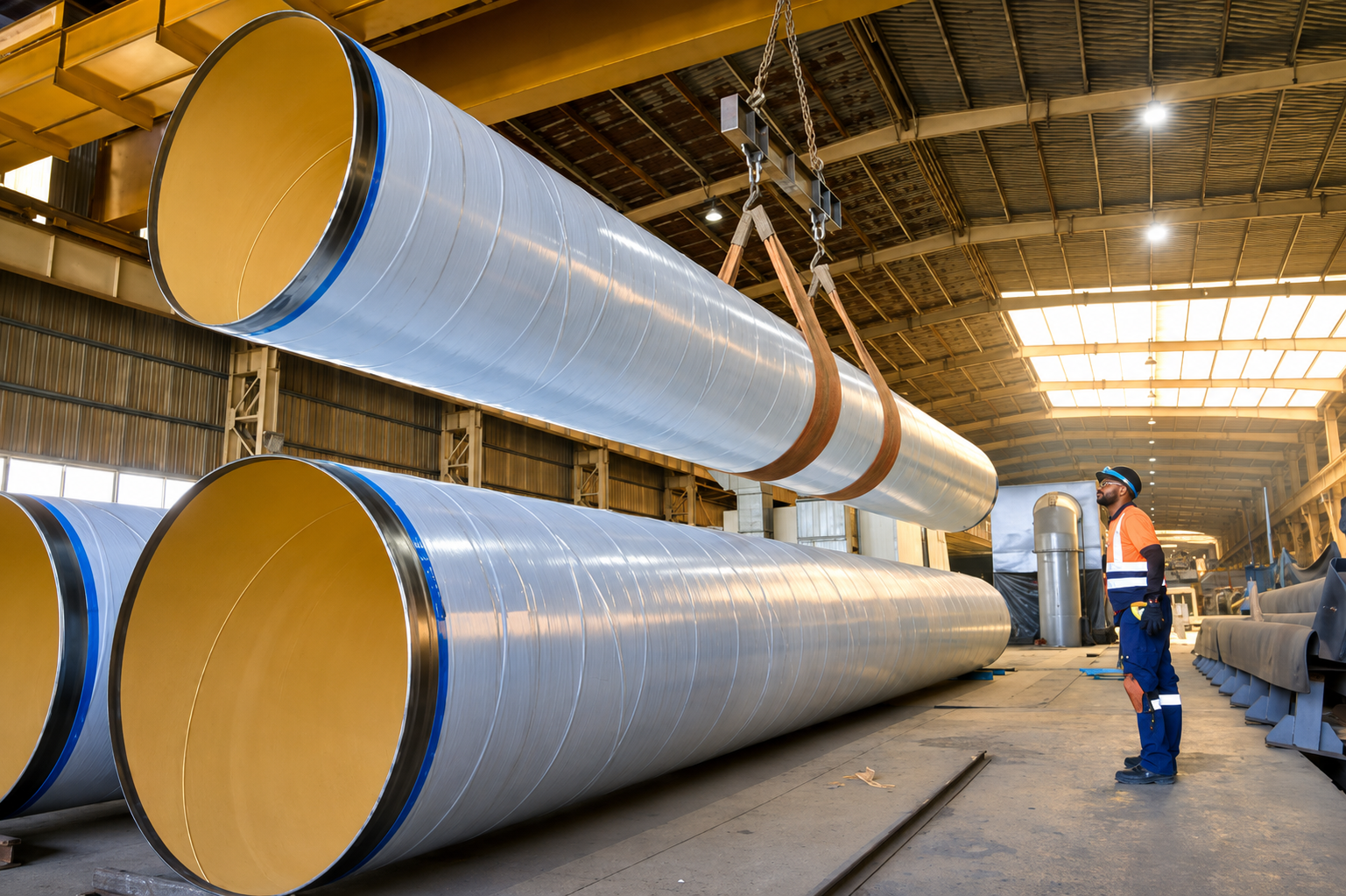
The new pipeline ranges from 1,000 mm to 1,600 mm in diameter and is designed not only to restore the aqueduct but to meet future demand more credibly. Just as importantly, the system introduces cross-connection chambers at roughly 1-km intervals between the twin pipes.
That spacing was one of the most revealing technical themes in the interview.
Colin Raman explained that cross-connections had existed in the previous system too — but at much wider intervals of around 5 km. The problem with that arrangement, he made clear, was not theoretical engineering elegance but operational pain. The larger the isolated section, the more water had to be drained, the longer repairs took, and the more severe the downstream impact became.
The new arrangement sharply improves control. As Raman put it during the discussion, the aim is to make sure that “**whenever there is a leak, we can isolate a section and the communities will never feel the difference**.” That is one of the defining ambitions of the project: not to pretend faults will never happen, but to make them far less disruptive when they do.
He also explained that the strategy of constructing cross-connections at 1km is a cost-effective design approach. This method enhances system redundancy without the need for larger, more expensive pipelines.
Maine, who came through in the interview as the strongest operational realist in the room, built on that point. He spoke about the number of hours required to fix major pipeline issues, the cost of extended shutdowns, and the need to activate water tankers when communities are affected. For a bulk-water line serving one-third of the city’s population, he made clear, even a repair window becomes a citywide event.
The implication is profound: the Southern Aqueduct is not only adding capacity; it is engineering down the cost of future failure.
Why redundancy matters financially
Infrastructure features often talk about redundancy as though it were an abstract technical luxury. In reality, redundancy is one of the most commercially rational design decisions a city can make.
Mtshali stressed that point in practical terms. When long sections of pipe have to be drained, the city loses large volumes of treated water. When repairs take too long, emergency measures must be introduced. When supply is interrupted at this scale, the disruption hits beyond households. Schools are affected. Daily routines are broken. Businesses lose continuity. Parts of the city’s productive life slow down.That is why Southern Aqueduct is also an economic story.
Reliable water supply is not simply a social good. It is business infrastructure. Industrial users, manufacturing plants, logistics ecosystems and growing urban communities all depend on the kind of invisible continuity this project is meant to safeguard. The hidden systems beneath cities determine far more of economic confidence than public debate often acknowledges.
Building for a harsher environment
If the new cross-connections represent a major operational improvement, the materials strategy reveals the project’s seriousness about lifespan.
Raman led the technical discussion on coatings, corrosion exposure and valve-chamber design. This is not a route that passes through neutral conditions. Parts of the corridor are exposed to highly corrosive influences associated with railways and electrical infrastructure, which makes corrosion control a central design issue rather than a secondary specification.
The project presentation shows that the new buried mild-steel pipeline is designed in compliance with SANS 719 API 5L, with thicknesses set according to pressure, external loading, soil conditions, handling and buckling requirements. Internally, the system uses solvent-free liquid epoxy to a minimum dry film thickness of 400 µm. Externally, the coating specification changes by environment, with visco-elastic polyisobutene coating (2LPE) used in highly corrosive areas and other high-spec systems applied elsewhere.
Raman also described how chamber design itself has been rethought. Older systems had been vulnerable not only to corrosion, but to vandalism and theft. The new reinforced concrete valve chambers are intended to protect critical components far more effectively and reduce one of the project’s recurring historical vulnerabilities.
That is one of the strongest aspects of the Southern Aqueduct upgrade: it does not merely replace old weaknesses with new material. It appears to have asked, in a disciplined way, why those weaknesses emerged in the first place.
Benefits already showing up before completion
One of the clearest signs that the project is well conceived is that it has already begun to generate operational value before full commissioning.
The project presentation notes that the existing steel pipeline, although much newer than the concrete one, had itself been under distress. Under the current programme, **vandalized or stolen air valves have been replaced**, secure chambers have been introduced, and inaccessible leaks at river crossings were made reachable for repair.
Mtshali emphasized another important shift: visibility.
He described how the new control-room capabilities and leak-detection approach will help the city identify probable leak zones faster, isolate them more effectively, and reduce water loss. In a network that crosses difficult terrain, rivers and environmentally sensitive areas, that level of visibility changes response times and improves sustainability.
The presentation supports that point with a strong operational indicator: real-time flows at almost 20 reservoirs are now available to the EWS Operations Department and have already helped the city balance water during the high-demand December-to-February period.
That is not yet a fully intelligent network. But it is no longer a blind one.
Laying the groundwork for smarter water management
The digitization section of the interview was one of the most promising, because it revealed that Southern Aqueduct is being built not only as hard infrastructure, but as a platform for more intelligent future control.
Colin Raman discussed telemetry, automated monitoring, water balancing and the possibility of integrating smarter control logic into the system over time. The key requirement, he said in effect, is data. Without meaningful reservoir levels, flow data, pressure data and actuation, there is little intelligence to build on. With that data, the network becomes manageable in a different way.
Christopher Maine then gave that point strategic weight. He described the project as scalable, capable of accepting additional layers of intelligence and control over time. Drawing on broader professional experience, including work in Atlanta, he made clear that Durban’s challenge is not unusual. Cities across the world are grappling with aging buried networks and the need to retrofit visibility, responsiveness and better operational intelligence into them. During the conversation, he used the phrase “smart water” to describe where this direction leads.
The project documentation gives that idea substance. When complete, the Southern Aqueduct will include a Water Network Monitoring System designed for a lifecycle of at least 15 to 20 years, with upgraded remote telemetry, instrumentation, communications reconfiguration, and replacement of the SCADA systems at the EWS base stations in Prior Road and Scott Road, using GEOSCADA software.
The significance of that is easy to miss. Southern Aqueduct is not simply being rebuilt to move water. It is being rebuilt to see water better — to understand flows, pressures and imbalances with a level of clarity that older systems rarely allowed.
Structuring the project to widen participation
The project’s delivery model deserves more attention than infrastructure stories often give to procurement.
Southern Aqueduct was unbundled into eight work packages, allowing a wider range of contractors to participate. That is more than a scheduling device. It is a capacity-building decision. The work was structured to accommodate contractor gradings down to 8CE, aligning packages with ward boundaries and local conditions while enabling as many as six contractors to operate simultaneously.
Raman made one of the interview’s most important points here. Performance bonds, he explained, can quietly exclude many local firms from major infrastructure opportunities. A single billion-rand package might immediately narrow participation to only a handful of large or multinational players. Smaller packages lower that threshold and open a path for more South African firms to gain experience on major works.
Mtshali reinforced the wider public value of that approach. More packages mean more engineers, more technicians, more trained workers, and more companies that emerge from the project stronger than they entered it. Over time, that helps deepen the local delivery base and improves the city’s future options.
A local industrial ecosystem in motion
Maine’s supplier discussion added another layer the feature would be weaker without: the supply chain behind the infrastructure.
The presentation notes that the pipes were manufactured at plants in Sasolburg and Vereeniging by South African owned companies, while coating and lining for primarily came from a KwaZulu-Natal-based company. Valves and fittings were sourced from KZN-based firms, including one **100% black-owned company. Under the 30% Contract Participation Goal, black-owned companies from disadvantaged communities were brought into work covering prefabricated pipe bends, welding, cathodic protection, reinforced-concrete chambers and road reinstatement.
During the interview, Raman identified key local suppliers including Africa Pipe Industries (API), Denso, LVSA, AVK, LW Tank Systems and the upstream steel role of ArcelorMittal. Those details matter because they show the project’s footprint goes well beyond the trench. It touches manufacturing, fabrication, coating, transport and skills across multiple parts of South Africa’s industrial base.
This is not just a water story. It is also a domestic capability story.
Young people, transferable skills and future capability
The workforce numbers are substantial. The project presentation records 431 people currently employed**, excluding the professional team, including 162 youth, while 270 people have been trained.
Asked about transferable skills, Raman spoke about the design side of the project — the opportunity to develop younger black technical staff in hydraulics, modelling and engineering work. Mtshali added a broader intergenerational point. Large projects of this kind do not come often. Many careers may pass without exposure to a scheme of this scale. Bringing young professionals into it now helps distribute knowledge and experience into the future of the sector.
That may prove one of the project’s least visible but most important outcomes: not just a new asset, but a stronger bench of people able to conceive, deliver and maintain the next generation of infrastructure.
The human work behind the engineering
If the physical engineering is impressive, the social management behind it may be just as important.
Mtshali’s reflections on stakeholder communication were among the most useful in the interview because they revealed how much public coordination is required to make technical delivery possible. He described the role of political leadership in communicating the project, the use of project steering committees, and the importance of informing communities not only about road closures and access restrictions, but also about employment and business opportunities tied to the works.
That approach is especially significant on a project moving through established urban areas, road reserves and environmentally sensitive zones. Public frustration can derail delivery long before technical problems do. Mtshali’s point was clear: communication is not a soft issue. It is part of the infrastructure.
He also led the environmental discussion, outlining the project’s biodiversity protections, restoration measures and rehabilitation responsibilities. Roads opened during construction are ultimately reinstated, and in some cases communities receive renewed surfaces and updated surrounding infrastructure in the process. Raman added that the works also created an opportunity to address adjacent sewer issues and reduce standing water linked to damaged infrastructure, while Maine noted that corridor projects like this can unlock a chance to fix other surrounding problems at the same time.
That is one of the more understated strengths of the scheme: it does not only install new pipe; it improves the condition of the corridor around it.
Defining the legacy
For all the technical detail, the deepest meaning of Southern Aqueduct may lie in what each of the interviewees said when asked about legacy.
Mtshali answered first and most directly. For him, this is a “life-altering type of a project.” He was speaking from the perspective of public service, but the phrase carries broader truth. Water is not an abstract utility. It shapes routine, health, dignity, education, business continuity and the daily stability of urban life. When bulk-water infrastructure fails, people feel it quickly. When it works well, it quietly protects almost everything else.
Raman’s answer shifted the frame from service delivery to social geography. What stood out to him, he said, was that the project serves Durban’s southern communities, areas that are often among the poorer parts of the city, and that substantial public money is being invested there. That makes the project’s legacy more than hydraulic. It becomes a statement about where infrastructure investment can create the deepest public value.
Maine’s answer reached across time. He spoke with appreciation for the engineering that came before, noting that parts of the previous system had continued operating well beyond the life their designers likely expected. That endurance, he suggested, was evidence of “decent engineering.” His hope now is that the quality, discipline and foresight going into Southern Aqueduct will produce similar resilience for the future.
Taken together, those views give the project its fullest meaning.
Southern Aqueduct is a bulk-water upgrade, a resilience project, a smart-network foundation, a contractor-development platform and a local industrial story. But above all, it is a reminder that cities are judged not only by the infrastructure they announce, but by the hidden systems they rebuild before failure becomes catastrophe.
The people who turn on taps across southern Durban may never know the diameter of the steel beneath them, the spacing of the cross-connection chambers, or the specification of the coatings protecting the line from corrosion.
They will know whether the system holds.
And in the end, that is how the best infrastructure is remembered.
 The Southern Aqueduct Project -EThekwini Municipality- BE Global Infrastructure Magazine spread.pdf