

Something extraordinary is happening in Chile. Across a sliver of land wedged between the Andes and the Pacific, a generational wave of infrastructure investment is reshaping the country's economic geography — and its place in the global energy transition. From the windswept tip of Patagonia to the Santiago commuter belt, ten mega-projects totalling more than $36 billion are moving from blueprint to reality.
Together they represent the most ambitious infrastructure programme in Chile's modern history: new metros, new rail lines, new highways, a new deep-water port, a transcontinental power link, and the world's most ambitious green hydrogen venture. This is the definitive guide to all ten — who is building them, what they cost, where they stand, and why they matter far beyond Chile's borders.This is the definitive guide to all ten — who is building them, what they cost, where they stand, and why they matter far beyond Chile's borders.
The Ten Projects
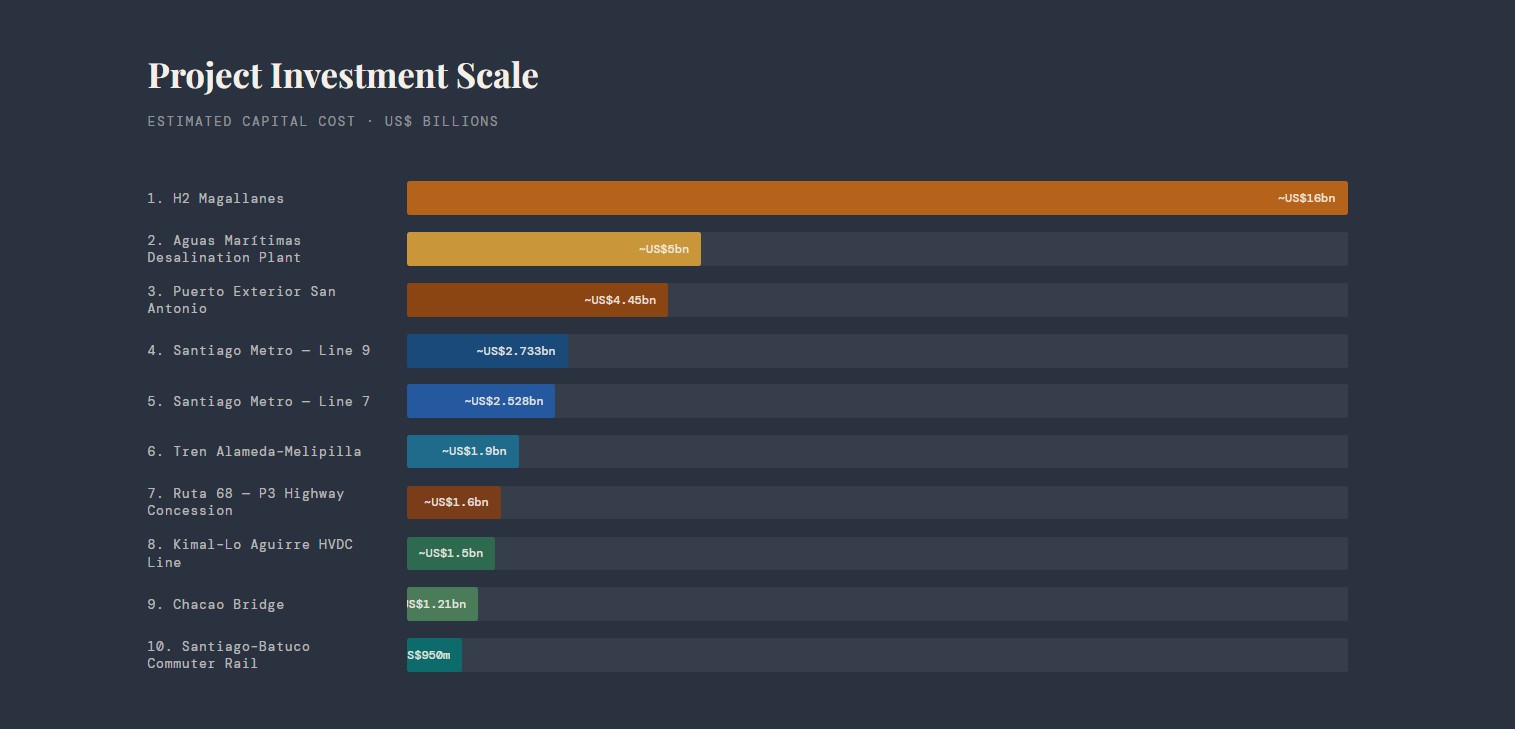
1. H2 Magallanes
The World's Most Ambitious Green Hydrogen Venture
US$16bn
At the bottom of the world, where Patagonian winds blow with unrelenting ferocity, TotalEnergies and its partners are planning the most audacious green hydrogen project ever attempted. H2 Magallanes is not a plant — it is an entire industrial ecosystem carved from wilderness.
The project would harness some of the planet's most powerful wind resources to drive a colossal electrolyser farm, splitting water into green hydrogen. That hydrogen would then be synthesised into green ammonia — far easier to transport — and shipped via purpose-built maritime infrastructure to global markets. The complex also requires desalination capacity to supply process water in one of Chile's most remote regions. At $16 billion, H2 Magallanes dwarfs every other project on this list combined. Its success could validate an entirely new global energy supply chain, positioning Chile as a 21st-century energy exporter to rival the Gulf states.
TechnologyWind + Electrolysis + Ammonia
OutputGreen ammonia for export
StageEnvironmental permitting
Sponsor(s)TEC H2 MAG / TotalEnergies
LocationMagallanes Region, far southern Chile
Key Suppliers/ Contractors
Developer / Lead: TEC H2 MAG SpA (Total Eren subsidiary)
Maritime Concession: CRUBC (approved Bahía Posesión port)- Chile (Gov.)
Ecosystem Partner: EDF Power Solutions Chile- France
Academic Partner: University of Magallanes- Chile
Ecosystem Partner: ACCIONA & Nordex Green Hydrogen- Spain / Germany
Ecosystem Partner- HNH Energy (AustriaEnergy, Copenhagen Infrastructure Partners, Ökowind) International
2. Aguas Marítimas Desalination Plant
Latin America's Largest Desalination Facility
~US$5bn
Chile's north is among the driest places on Earth. The Atacama Desert receives less annual rainfall than the Sahara, yet it hosts the country's most productive mining sector — a fundamental contradiction that has long constrained growth. The Aguas Marítimas desalination plant is designed to resolve it.
With a price tag of approximately $5 billion, this project would become not just Chile's but Latin America's largest desalination facility by capacity. By drawing on the Pacific Ocean and processing seawater at industrial scale, it would supply water to mining operations, municipalities and agriculture across the parched north — reducing pressure on already over-stressed underground aquifers. The project is currently navigating Chile's environmental impact assessment process, one of the most rigorous in the developing world. Its approval and construction would mark a watershed moment — literally — for Chile's water security strategy.
Type: Reverse osmosis desalination
Beneficiaries: Mining, municipal, agriculture
Stage: EIA process
Sponsor(s): Aguas Marítimas S.A.
Location: Northern Chile (Atacama region)
3. Puerto Exterior San Antonio
Chile's Gateway to Global Trade, Reimagined
~US$4.45bn
San Antonio is already Chile's busiest port, handling the lion's share of the country's container traffic. But its existing infrastructure is reaching capacity, and its shallow draught limits access to the next generation of ultra-large container vessels that now dominate global shipping.
The Puerto Exterior — the San Antonio Outer Port — is the answer: a brand-new deep-water terminal built on reclaimed land to the south of the existing port. The masterplan totals $4.45 billion, with a core works package of approximately $1.95 billion covering the critical breakwater, dredging and quay construction. When complete, it will accommodate vessels of 18,000+ TEU and catapult Chile's trade gateway capacity into the top tier of South American port infrastructure. The tender process is advancing, with major international port operators and construction groups eyeing the contracts.
Capacity: Ultra-large container vessels
Core Works: US$1.95bn breakwater + dredging
Stage: Tender / pre-award
Sponsor(s): Puerto San Antonio (state-backed)
Location: San Antonio, Valparaíso Region
4. Santiago Metro — Line 9
The Capital's New North–South Spine
~US$2.733bn
Santiago is a city of seven million people squeezed between the Andes and the coastal range. Its metro system — one of Latin America's finest — has long needed a new north–south axis to relieve pressure on the overloaded Lines 1 and 2. Line 9 is that axis.
Running from the northern communes deep into the south of the city, Line 9 will serve densely populated corridors that currently depend heavily on surface buses — journeys that can take an hour by road but will be achieved in a fraction of the time underground. At $2.733 billion it is the most expensive urban transit project currently under construction in Chile. Works have been formally launched, with tunnelling and civil work expected to ramp up through 2025–2026. The line is expected to carry hundreds of thousands of passengers daily, dramatically improving urban equity by connecting lower-income southern suburbs to the city's economic core.
RouteNorth–south corridor
ImpactMajor commuter relief
StageWorks launched
Sponsor(s)Metro de Santiago / Ministry of Transport
LocationSantiago Metropolitan Region
Development Progress: 18%
5. Santiago Metro — Line 7
East–West Connectivity Across the Capital
~US$2.528bn
While Line 9 addresses Santiago's north–south mobility gap, Line 7 tackles the perpendicular challenge: connecting the city's eastern residential and commercial districts to the west. Running through central Santiago and into the eastern foothills, it crosses multiple existing metro lines, creating a new interchange web.
At $2.528 billion and currently under active construction, Line 7 is one of the most complex engineering projects in the country. It must be built beneath an already dense urban fabric, navigating existing utility infrastructure, heritage buildings and active metro tunnels. The line will serve high-demand origin-destination pairs that are currently poorly served by direct rail, reducing reliance on private vehicles in a city chronically afflicted by air pollution inversions. With construction well advanced, Line 7 is on track to begin transforming how Santiago moves.
Route: East–west corridor
Complexity: Urban tunnelling, multiple crossings
Stage: Active construction
Sponsor(s): Metro de Santiago / Ministry of Transport
Location: Santiago Metropolitan Region
Development Progress:35%
6. Tren Alameda–Melipilla
61 Kilometres of Commuter Rail Revival
~US$1.9bn
For decades, the rail corridor west of Santiago fell into decline as Chileans embraced the car and the highway. Tren Alameda–Melipilla is the reversal of that trend: a 61-kilometre commuter rail line with 11 stations reconnecting the western metropolitan region to central Santiago.
Operated by EFE, Chile's state railway, the project involves new track, electrification, modern rolling stock and rebuilt stations across a corridor that serves fast-growing suburban communities. At $1.9 billion it represents a major commitment to modal shift — taking private vehicles off the congested Autopista del Sol and replacing car trips with clean electric train journeys. Works have started, with civil contractors mobilised across multiple station sites and track sections. The project also serves as a proof of concept for Chile's wider suburban rail ambitions, which extend to multiple other corridors in the Santiago metropolitan area.
Length61 km, 11 stations
Operator: EFE
Stage: Works started
Sponsor(s): EFE (Empresa de Ferrocarriles del Estado)
Location: Santiago west to Melipilla
Development Progress: 22%
7. Ruta 68 — P3 Highway Concession
Modernising the Santiago–Valparaíso Lifeline
~US$1.6bn
Ruta 68 is arguably Chile's most strategically vital highway — the artery connecting Santiago to the port city of Valparaíso and the resort of Viña del Mar. It carries freight, commuters and tourists in volumes that have long outgrown its existing capacity.
The P3 (Public-Private Partnership) concession will fund a comprehensive modernisation and expansion of the corridor: widened lanes, new interchanges, tunnels to bypass bottlenecks, and upgraded safety infrastructure throughout. At $1.6 billion it is one of the largest highway concession packages currently being advanced in South America. The structure — private capital, user tolls, government availability payments — represents Chile's preferred model for infrastructure finance, and has attracted serious interest from major global concessionaires. Completion will dramatically cut journey times and improve freight reliability between the capital and its key Pacific gateway.
Structure: P3 / PPP concession
Corridor: Santiago ↔ Valparaíso
Stage: Concession / works advancing
Sponsor(s): MOP / Private Concession
Location: Santiago to Valparaíso / Viña del Mar
Development Progress: 30%
8. Kimal–Lo Aguirre HVDC Line
1,346 km of Clean Energy Superhighway
~US$1.5bn
Chile has a paradox: its best solar and wind resources are in the remote north, while most of its electricity demand is in Santiago and the south. The Kimal–Lo Aguirre HVDC line is the infrastructure that resolves this paradox — a 1,346-kilometre high-voltage direct-current transmission superhighway running from the Atacama to the capital.
At 3 GW of transmission capacity, the line will carry enough power to supply millions of homes, enabling the full commercialisation of Chile's extraordinary renewable energy endowment. HVDC technology is the only practical way to move large amounts of power across such distances with acceptable losses. Construction began in early 2026, marking a decisive step in Chile's energy transition. The line will not only benefit domestic consumers but will be critical infrastructure for future green hydrogen and e-fuel export projects, including H2 Magallanes, which ultimately need to demonstrate that northern Chile's renewable electricity can reach processing facilities efficiently.
Length: 1,346 km
Capacity: 3 GW HVDC
Stage: Construction started Feb 2026
Sponsor(s): Conexión Energía (state-backed)
Location: Atacama to Santiago Metropolitan Region
Development Progress: 15%
9. Chacao Bridge
Connecting the Island of Chiloé to the Mainland
~US$1.21bn
For centuries, Chiloé — Chile's second-largest island and one of its most distinctive cultural regions — has been accessible only by ferry across the turbulent Chacao Channel. The Chacao Bridge will change that forever.
Spanning approximately 2.7 kilometres across a notoriously challenging strait marked by powerful tidal currents, the bridge is one of the most technically demanding engineering projects in South American history. The channel's extreme current velocities required innovative foundation designs, while seismic risks in one of the world's most active earthquake zones demanded sophisticated structural engineering solutions. With a current budget of approximately $1.21 billion (per the latest government update) and construction actively progressing, the bridge is one of Chile's most emotionally resonant infrastructure projects — connecting a community that has long felt geographically and economically isolated. Progress updates in 2026 indicate construction advancing on key structural elements.
Span~2.7 km across Chacao Channel
Challenge: Extreme tides + seismic zone
Stage: Under construction
Sponsor(s): MOP / International consortium
Location: Chacao Channel, Los Lagos Region
Development Progress: 16%
10. Santiago–Batuco Commuter Rail
Extending the Rail Network to Santiago's Northern Fringe
~US$950m
Santiago's northern periphery — a sprawling zone of logistics hubs, industrial facilities and working-class residential districts — has long been underserved by rail. The Santiago–Batuco commuter rail project changes that, extending the suburban rail network northward for the first time in modern Chile.
At approximately $950 million, it is the most modestly scaled project on this list — but in terms of social impact per dollar, it may rank among the highest. The corridor serves communities with limited mobility alternatives, high rates of car dependence and some of the worst commute times in the metropolitan area. Civil works contracting is underway, with EFE managing early-stage delivery. The project complements the Alameda–Melipilla line as part of a broader vision to give Santiago a true suburban rail network — transforming the city's commuter geography and reducing its dependence on a road network that has reached saturation.
Route: Santiago north → Batuco
Operator: EFE
Stage: Civil works contracting
Sponsor(s): EFE (Empresa de Ferrocarriles del Estado)
Location: Santiago north to Batuco
Development Progress: 16%
Frequently Asked Questions
People also ask about Chile's infrastructure boom
The ten largest infrastructure projects currently active in Chile total approximately US$36.4 billion in estimated capital cost. This figure covers projects across energy, transport, water and maritime sectors — making Chile's current infrastructure programme one of the largest per-capita in South America.
H2 Magallanes is a US$16 billion green hydrogen and ammonia mega-hub planned for Chile's Patagonia region, led by TEC H2 MAG in partnership with TotalEnergies. It would use the region's extraordinary wind resources to power electrolysers that split water into green hydrogen, which is then synthesised into green ammonia for export. If realised at scale, it could make Chile one of the world's leading clean energy exporters.
Line 7 is the more advanced of the two, with active tunnelling and civil works underway. Line 9 has formally launched works as of 2025. Both lines are expected to open in stages during the late 2020s, though official inauguration dates remain subject to construction progress. Santiago Metro has a strong track record of delivering new lines within projected timeframes.
The Chacao Bridge is a ~2.7 km bridge across the Chacao Channel connecting mainland Chile to the island of Chiloé. It is currently under construction with a budget of approximately US$1.21 billion. Construction is actively progressing as of 2026, with completion expected in the late 2020s, though the exact timeline depends on resolution of engineering and logistical challenges in the challenging marine environment.
The 1,346 km, 3 GW HVDC line will transport renewable electricity from Chile's solar- and wind-rich north to demand centres in Santiago and central Chile. This is critical for the energy transition because it unlocks the full commercial potential of the Atacama's world-class solar resources. Construction began in early 2026. The line will also support future green hydrogen export projects by making northern renewable power accessible at scale.
The ten projects span four sectors: energy (green hydrogen, HVDC transmission), transport (metro, commuter rail, highway, bridge), water (desalination) and maritime/port infrastructure. Transport dominates by project count, while energy dominates by value — with H2 Magallanes alone accounting for 44% of the total pipeline value.